Tuesday, October 8, 2013

Dog Aggression -- the Hard Way (Conclusion)


The cause of their fights was our fault.

It took many weeks after that dog fight, during the process of healing and more researching that the truth finally dawned on me. I recalled the first doggy fight I saw at the driveway and compared it to that last one where I got bitten. There was a difference. In those initial first brawls, Butchie Boy was the aggressor. In the last brawl, it was Spot.

The cause of their fights, I discovered, was our fault.

Dogs follow a social hierarchy among themselves. There is a dominant leader, the Senior or Top Dog, and there are the followers. They are wired to observe this and a dog owner not aware of this will cause dogs to brawl among themselves as they fight for their positions.

I had brainwashed Spot to believe he was the Top Dog because he was the family favorite. Simultaneously, Butchie Boy, having been there first, believed he deserved respect as the Top Dog. I did not teach Spot that – neither did we observe it as his humans. We had totally ignored the Boxer and whatever he had felt were his rights. We had petted Spot first, walked him first, put him his collar first, fed him first, and given him priority over everything in their lives together. That’s why the Boxer despised the Dalmatian newcomer from the start.

Finally identifying the cause of the fight, I concentrated now on this phenomenon called their canine social hierarchy. We had a lot of un-doing to do.

We started to observe the Boxer’s seniority over Spot by respecting his position first. He was fed first, given his collar first, and walked first.

The brawls were reduced considerably but they were not completely eradicated. Upon my arrival from work, to my disappointment I would sometimes receive reports from our househelp that there was a dog fight that day. But the dog fights were always instigated, this time, by Spot. Spot was now the aggressor, Butchie Boy was the defender.

In the end, it was Butchie Boy that lost his home. I had plans for Spot and wanted him for further training as a career agility dog. We rehomed Butchie Boy as Spot persisted in asserting his belief he was the Top Dog. As long as those two dogs lived with us, there would be no peace.

As Butchie Boy left us, Spot was our only dog for several months until I slowly built up a new pack. But by then, I knew how to handle our multi-dog household. I taught the other dogs their respective positions while assuring Spot he remained Top Dog. Each dog had his position no. 1, no. 2 and no. 3 and this was firmly observed by all of us, a method I picked up from Dr. Dodson’s book. In later years, as I met our famous dog whisperer, Fred Alimusa, I learned that petting Spot in front of the other dogs do not bother them as long as they know their positions.
 
My spotted pack a few years ago. "J.R." (left, back) is Spot's son, an accidental mix with a border collie. In foreground (center) is Toby. Their hierarchical positions are (l-r): dog number 3, 2, then 1 (Spot). We followed this social order of theirs strictly to avoid doggy squabbles.
Dogs are not humans. They do not react as humans do. What we humans dub as “jealousy” is a dog just asserting his position over an upstart trying to bypass him.

Sounds like corporate culture huh?   

Saturday, October 5, 2013

Small Dog, Big Space

If you believe in yourself, you will make it -- even in a world of giants.


           At present, Packy, our lively and spirited Dachshund is on "vacation" visiting his girlfriend. He will be gone for a week. We're back to 3 dogs, all medium-sized -- 2 Dalmatians and 1 native dog with mixed German Shepherd blood (the adopted).

           The Dachshund Packy came into our lives, a gift from my cousin Marie, 7 years ago. But Packy was not our first encounter with his breed. Earlier there was another Dachshund named Tootsie. But Tootsie wasn't ours. She was stationed with us for awhile for housebreaking until Marie could take her home to keep her elderly mother company.

           When Tootsie came into our house as a 3-month old puppy she was small as a rat. But very lively. Her playmates towered above her -- a Boxer and a Dalmatian -- but the instigator to all those chases and wrestling matches was Tootsie. My elderly dad would watch the dogs at play, crossing and re-crossing the open doorway of his ground floor bedroom, wrestling and chasing each other until we could hear their breathless puffs. He would marvel at how that little pup could lead the pack from start to finish. Tootsie had no concept of size. "She doesn't know how small she is," my dad would remark.

            Frankly, my own observation on life from that little dog's attitude was a marvel: if you believe in yourself, you will make it even in a world of giants!

Tootsie cozies herself up to Spot during naptime.
           After a month, Tootsie's training period ended and my cousin Marie came to pick her up. But she saw the look in my dad's face. That little lively Dachshund pup who gave him so many days of amusement at her antics, would be with us no more. The result -- Marie sent my dad a new Dachshund pup a few weeks later. That was how Packy came to live with us.

           Packy had a different temperament, however. He was not as playful as Tootsie. He was more serious. What was more important to him was his leadership in the pack -- and asserting it. By that time I had 2 Dalmatians (the Boxer died already) so his packmates were taller than he. In their canine hierarchy at home, he was Dog No.3. But to be No.3 -- he refused. He kept bullying our Dog No. 2, our Dalmatian named Toby. After careful thought and noticing Toby's submissive nature, I switched the 2 dogs' positions, moving Packy up as Dog No.2 and Toby down as Dog No.3. Toby accepted his new social assignment obediently.

           Would Packy try to displace Spotty, my Dog No.1 too? I saw him trying. The Dachshund was more assertive; the Dalmatians were submissive. But to be sure, I defended Spot's social position. I knew Spot was accustomed to his position as the Top Dog. 

           In Packy's attempts to climb one more rung up the canine social ladder to displace Spot, there would be fights. I saw that Spot will not give way. For example, when it's walk time and the dogs get excited, my maids are instructed to follow the sequencing: Spot, Packy, then Toby. But because Packy is so noisy and assertive, sometimes the maid would be pressured to choose him first.

          The brawls would be ear-splitting. I'd hear Packy's hysterical screams loud enough to raise the dead above Spot's throaty growls. We'd rush to the scene and find the little dog grabbed by the scruff of his neck by the bigger Dalmatian and shaken vigorously side to side like a little rat. My maid would pull Spot's hind legs to distract the angry older dog and this would cause Spot to release the struggling Packy. But do you think that would end it? As soon as I get Packy in my hands the dog would slip out of my grasp quickly and attack right back! Screaming his head off he'd leap back towards Spot to continue the brawl.
   
Packy crosses the 4-foot high dog walk agility equipment. Though the bar jumps are barred from Dachshunds because of their long spine, Packy does well on the contact equipment (seesaw, dog walk, and tunnels)
           But Packy is not all tension and trouble. One of the most delightful experiences I have with him was when I tried to restore my childhood memories of dogs howling at the church bells located a block behind our house. I've lived here since I was born and the church behind us has grown bigger to one day have huge bells installed in their bell tower. When I was a kid we had 7 native dogs and we'd have an earful of howling and singing dogs every time the bells rang for Angelus, everyday for Mass, at Easter dawn Mass, or for midnight Christmas Mass. Life was simple then, and the problems of modern man and congested city life was yet unheard of. So when urbanization reached fever pitch level many years later, a "noise pollution" complaint was raised in the neighborhood. The priests ceased to use the bells. For the next several decades the church bells were silent. As a result our dogs had no chiming bells to howl to -- and nothing to pass on to next-generation pack members.
   
           But by the next century, Packy revived it. One day the church, now a cathedral shrine, decided to revive the old customs. When the bells rang merrily in the air after a silence of 5 decades, Packy howled long and hard at it. Oh wait, he did not howl. It was more of a rap. It was a fast staccato kind of bark with rhythmic pauses, like he was rapping. A week after, Toby the Dalmatian picked it up, like a back-up singer. Toby howled like a real dog, his neck stretched to the sky, howling to his heart's content.
   
           Our childhood "landmark" memory was restored by Packy.
   
           Living with a Dachshund gives you stories to remember during his lifetime. The breed is feisty, lively, creative, independent, will try to outsmart you, and will always entertain you.
Packy emotes like a canine model at a Christmas greeting pictorial I did last year for an e-card to send to friends and family.
           However, when Packy left us to live with his girlfriend for a week, this small little dog left a void in our lives. The house fell silent. I didn't know what "real gentlemen" my other dogs were. Dalmatians are known to bark sparingly and I finally saw that trait. I realized that little dog influenced the rest of the pack, making the rest noisy and rowdy as he was. But with Packy gone, the dogs were well behaved. Gone was the rivalry. When there was a visitor they came to inspect but there was no competition. They didn't jump, bark, and bump around.
   
           The day after Packy left, the church bells rang that early morning at 6:00am. I was half-expecting to hear the usual racket. Our half-darkened house echoed with the sound of the bells but no dog howled. With no Packy to instigate it, no dog howled at the bells.
   
           In our house, it's Packy who influences the pack. This little dog truly believes in himself that our bigger dogs have learned to follow him.  

The Vet Survival Kit


“That’s Spot’s favorite!” I exclaimed. “He’ll go crazy over that!” Fred gave me a knowing eye. “That’s the idea,” he said.

Today, at eleven years of age (or 60 years old in human terms), my star Dalmatian Spotty has gone through 6 vets. I first brought him to a famous vet when he was a puppy and everything would have stayed alright as he grew older. But the line of patients was often long in that clinic and our waiting period would take all morning. If Spotty just needed a regular check-up or a simple vaccination, sitting at that reception lounge all morning wasn’t worth it. I thought of trying the neighborhood vets next time.

I tried 2 vets nearby back home but with disastrous results. Though they did a good job giving Spot his stitches after the usual dog fights of his reckless youth, the dog always remembered his experience with them. He froze every time we were a few meters away from their clinics on our afternoon walks. We could not pass in front of them.

Clear signs of traumatic memories here.

The fourth vet I knew was familiar to Spot but the relationship between them wouldn’t work. Spot knew her from our agility practices because she was often there. When I took him to her clinic for the first time, the dog was about to alight from my SUV when he suddenly glimpsed the vet clinic outside (how he knew it was a clinic I didn't know it yet) and the glint of terror flashed in his eyes. His face broke into disappointment and he whirled back inside and froze. The vet had to enter the vehicle to give him his shots. I watched as she instructed Dominic, who was with me, to hug the trembling dog. We did not manage that situation well for the dog’s sake.

During one walk with Spot in my neighborhood one afternoon, the dog froze like a rock as we passed a bank office. I almost fell over my face when the leash suddenly strained with no warning. I tugged, not understanding what the dog was upset about. But he refused to budge. I looked at his locked forelegs and frozen stance, a dead weight. I recognized the reaction as identical to his fear whenever he saw his former vet clinics. Then I noticed that the bank had a glass façade, just like those vet clinics. He probably thought I was going to bring him to one of those places he dreaded so much. So I let the dog rest and collect himself, then a few moments later upon realizing we were not going to enter the building, he stood up and followed me. 

Toby (left) and Spotty (right) all dressed for a Halloween event wait in anticipation inside my SUV. Drives are always exciting times for dogs but when they find themselves being delivered to a vet -- it's the ultimate spoiler of their trust.

Spot’s “puppy” vet’s clinic had no such glass façade it being a residence. We returned there the next time Spot needed a check-up. She was surely a familiar face (or smell) to the dog and I expected Spot would trust her.

But Spot didn’t trust her either. The dog froze as we approached the examination table and he refused to climb it even when it was lowered to its lowest. An aide had to lift him up, we had to muzzle him, and I had to distract him with a head massage (in my amateurish way) while he trembled, salivated nervously, and growled as the vet got blood samples.

In that visit, it turned out Spot had ehrlichiosis. This called for a round of checkups and blood samples. We were to return in 2 weeks. By then, I knew my dog enough. After that first visit – Spot will not want to go back there again.  

I will have a problem in my hands.

That was when I touched base again with the country’s first dog whisperer, Fred Alimusa. Fred lived on a beautiful hillside property in Amadeo, Cavite. It would be a long drive away. But I had a traumatized dog in my hands and I needed his expertise.

At my one-on-one session, Fred explained that his aim was to condition Spot to like going to the vet. First, because every dog needs a pack leader to feel secure, I have to assure Spot that I was in charge of the situation. We performed the heel-and-sit exercise many times at the house. Next we got the dog to climb on top of a low table as if it was the examination table at the vet clinic. These exercises were to assert my authority as the dog obeyed my commands. I was to make Spot understand that I was his leader and that I will take care of him. “Don’t worry, sagot kita (I will answer for you)!” was Fred’s favorite expression so Spot will remember to trust me when he starts to feel anxious.

Next, we drove off to nearby Tagaytay to find an available vet clinic. Along the ridge, we stopped by a store selling freshly made pork cracklings. Fred chose the ones with a bit of meat attached to the skins. “That’s Spot’s favorite!” I exclaimed. “He’ll go crazy over that!”

Fred gave me a knowing eye. “That’s the idea,” he said.

Upon arriving at a vet clinic (another glass façade), we did not enter the premises right away. We were now in an actual situation. Fred made me do several heel-and-sit exercises at the parking lot. Under his instruction, I edged toward the clinic with every round we made. Once, we stopped right before the door, but we turned away and made another round of heel-and-sit. Finally we entered. Spot followed obediently.

Inside the clinic, I carried that bag of pork cracklings. It was my bait — and also my reward. At my command, the dog climbed the examination table obediently (mouth salivating, I bet) and after he had done so, I gave him a fresh crispy tidbit which Spot crunched happily.

After our dry run session at the clinic, Fred reminded me never to feed Spot his favorite snack food unless it’s at the vet clinic. “Only at the vet clinic,” he emphasized. “That way, every time he sees the vet clinic, he will salivate just thinking of his favorite treat. He knows that’s where he will taste it.”

Of course, the actual vet visit still had some differences and though I wished badly that Fred was there, he had his confidence in me. He knew I would be able to manage it. At Spot’s return visit to his “puppy” vet, I walked him up and down the road first, doing the heel-and-sit exercise, then I turned towards the gate leading to the clinic (no glass façade this time) — and Spot followed. I had with me a small container of barbecued meat (cracklings are high in salt and uric acid for dogs and although they love it so much I chose a safer treat for them. Besides, they don't eat barbecued meat often either).

When Spot’s turn came, the dog surprisingly entered the treatment room with me and climbed the examination table at my command. He had some anxieties but he was manageable. But I did not cuddle him. I fed him bits of meat sporadically while he was on the table to keep him distracted.  The blood sampling was a little tricky because I knew if Spot saw that and I gave him enough time to react to it, he will be too upset to want a treat. This was a case of timing. So I moved first and distracted him at once with a treat. The vet got the samples. The dog did not prove to be difficult.

In subsequent months, as I brought the other dogs to the state university vet hospital, Spot would come along as “moral support,” as the student vets there described him in amusement. I noticed the university hospital seemed an ideal place for dogs. The open corridors and breezy rooms contained no smells that reeked of fear or medicines enough to scare any doggy patient. Noticing Spot showed no reaction whenever he entered the treatment room to accompany a pack member dog, I ended up registering him there as a patient. On weekdays, the waiting period is so short. I always carry our Vet Survival Kit — a small container of barbecued meat whenever we go to the vet hospital because it has worked so well.

“I do not know of any dog who will not work for a piece of barbecue,” Fred once told me. 
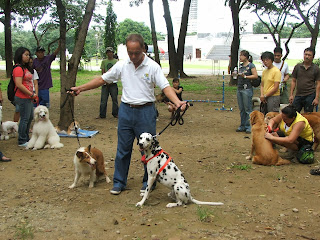
Fred Alimusa shows how to rehabilitate dogs with aggression problems, in this case Toby (at right) who has trouble meeting new dogs. He left behind a legacy of invaluable learning that we can never never replace. We learned to understand our dogs because of him.
Now to our dogs, the vet clinic is a happy place where they get to taste barbecue!


The Dogs Survive a Thunderstorm


Though I could see the dog’s anxiety in his eyes, I knew how to deal with it. Rule no. 1: DO NOT INDULGE HIS ANXIETIES.

It’s rainy season here now after a long hard summer. After a hot and muggy season, when the rains come Mother Nature compensates with a vengeance. The rains fall in torrents capable of causing flash floods throughout the city and snarling traffic till midnight.
           
            Just a few nights ago, I was up late, reading at our kitchen counter when the rains fell again, accompanied by thunder and lightning. Toto barked nervously at the sudden explosions of noise and came close to me. Every time lightning cracked and the thunder blasted, he’d jump at the sound, clearly distressed and bark at the sound. Suddenly, I felt the gentle presence of a doe-eyed dog sitting and looking up at me near my lap. It was Spot. He had risen from his doggy bed in my bedroom and had walked to where I sat on a stool at the counter. He was quiet. He just wanted to be with me.  
Spot in his doggy basket. He woke up during a thunderstorm, noticed I wasn't on my bed, rose and sought my company to assuage his fears.

             I stayed calm and undisturbed. Dogs learn from their masters and my reaction to the thunder claps would reinforce their fears.
           
           Though I could see Spot’s anxiety in his eyes, I knew how to deal with it. Rule no. 1: DO NOT INDULGE HIS ANXIETIES.
          
            I held myself from cuddling or petting him. I didn’t want to reinforce his feelings at that moment by rewarding it. That's why I didn't want to "comfort" Toto as he jumped at the thunder. I remembered the power of a dog’s focus and the 2 dogs were focused on the thunder. My job was to divert it.
           
            It had been quite awhile since we’ve done some training together but my learning hasn’t stopped. When I take Spot to the vet, I’ve learned not to cuddle and soothe the dog when he’s upset. That will reinforce it. But what do you do instead to calm his nervousness? I discovered the solution by accident with our fourth dog, Toto. During one of Toto’s visits to the vet, I held a small container of barbecued meat, a lesson I learned from dog behaviorist Fred Alimusa. The aroma was mouthwatering and it distracted the dog considerably. The first time I did this method, it was with Spot and I would feed Spot with bits of the meat while he was on the examination table. 

           But Toto showed me a better way. As he kept straining to reach the container, I kept pulling it away from him. That's when I noticed the dog was so focused on the container he didn't notice anything else. Eureka. So I kept the container, lid partially open, a tongue lick away. As Toto stretched with all his might sniffing and trying to get a tidbit, the vet behind him successfully delivered his vaccination and the dog never noticed it. He was so distracted with the temptation of the barbecue.
             
           He got lots of barbecued tidbits in that container, of course, when his treatment was finished. 

            So as the thunder rumbled and rolled up in the night sky, Toto jumped nervously and Spot looked at me quietly but anxiously. I knew what to do. Rule no. 2: DISTRACTION DISPELLS THE STRESS.
           
            I reached across the counter where the dogs’ biscuit jar was located. This was the best time to do a training session!
             
           The 2 dogs immediately went on alert mode at the sight of the biscuit jar being unscrewed. I reviewed Spot’s common tricks: “Speak” and “Shake hands.” Spot used to take time to gather enough power to make a bark but this time — even with the explosions of thunder above him — but seeing the biscuit waiting at my fingers, he barked readily. “Good boy,” I practically squealed, rewarding him.  Toto, meanwhile, had a natural tendency to stand on his hind legs, forelegs high in the air. I decided to work from there. “Dance!” I commanded, lifting a biscuit above his nose. Toto rose on his back legs, eyes burning brightly for the reward, totally focused on it. I let the dog stay in that position, letting him walk a bit, before lowering the biscuit to the floor and praising him when he got it. All this happened while the thunder rolled like a pile of bowling pins tumbling in the night sky.
           
           The dogs didn’t notice it. All of a sudden, their attention was elsewhere. Spot’s anxieties disappeared as his mouth watered for a biscuit and waited for his turn. Toto’s nervousness was forgotten too. He was being rewarded for doing something and he wanted to keep doing it!
            
            Next time thunder rolls in the sky, oh my. The dogs might come to me expecting a training session!   

And Toto Makes 4

This was my chance to test the truth of this breed’s usefulness.  


      It’s been two years since I last made an entry into this blog. A lot have happened since. Of course, my knowledge on the canine culture and their way of thinking has increased some more during that time. I learned how to train our 4-legged household members to conform to our ways of living in this house. I also learned how to teach them a few tricks.

      But with my star Dalmatian Spotty growing too old now for agility — I had no other Dalmatian to follow in his footsteps. My other Dalmatian, Toby, had too many emotional issues to qualify for competition. So my mind shifted to our native mutts. Can I handle a native dog, I wondered.

      The native dog first caught my attention when I visited the widow of my mentor, the late dog behaviorist Fred Alimusa (yes, he’s been training the dogs over at the Rainbow Bridge for over a year now). I once visited his farm a few weeks after he was taken by brain cancer. Fred used his farm as a location for his training segment in the weekly show, Dog TV. The house sat at the top of a slope and there were three cottages there – the main house on the top level, the dining area on the middle level, and a one-bedroom guest cottage on the lower level. The Alimusa property was a wonderful and windy place with a fabulous view of forests, hills, and the metropolis in the distance.

      I knew Fred had left behind a handsome Rottweiller and a handful of Beagles housed in a row of kennels. But when I descended the stone steps to go to the dining cottage down the slope, I was greeted by a pack of native mutts who emerged from their dens and barked defensively, threatening to chase me. Huh? Fred has native dogs here? A yard boy shushed them away and the dogs retreated.

      Later, when I returned to the main house, I asked Rina, Fred’s widow, why there were natives down the property. “Fred said they make good perimeter dogs,” she informed me.

      Oh. So that’s what the native mutt is useful for. Weeks later, a friend offered me one of his native mutts for rehoming. I accepted readily. This was my chance to test the truth of this breed’s usefulness. Plus — to see if I can train one too.

      That’s how Toto came into our household, assigned as Dog No. 4. Small-boned, light of feet and wavy haired, he had the coloring of a German Shepherd. But that’s as far as the similarity went.

      On his first night with us, recalling Alimusa’s teaching that the native was a “perimeter dog,” I assigned Toto outdoors. I lured our newcomer with a biscuit to go out the door before we turned in for the night. Toto followed the bait and settled into a corner before our front door. “Guard duty,” was what I told him to do.

      Our maid, Lourdes, however, reported an observation. During the night, she heard Toto’s occasional bark coming from the front yard, then later in the backyard. All that – while our purebreds were indoors, slumbering peacefully in their cushioned beds and pillows. In contrast, our native mutt was awake all night doing guard duty.

Toto poses shyly beside our Christmas tree last year where he was assigned the "a" of  "...and a Happy New Year" greeting set I composed in an e-card.
      A few days later, when the rains came, Toto resisted to spend the night outside, preferring to stay indoors. Unfortunately, he was not welcome in any of the bedrooms because our purebreds had a claim to them. So he settled in the front part of the house. I put out the light and left him in the dark to sleep with no company.

      During the night, however, I heard Toto pacing. We have wooden floors and I could hear his soft padding around the house. He was patrolling! He was doing something none of our indulgent purebreds never did! I heard his footsteps linger outside my door (I leave the door ajar so Spot can go out when he wants to), felt him peer in, then heard him turn around and move on. All this he’d do in the shadowy darkness of the house.

      So this is the behavior of a “perimeter dog.” This is our “Bantay” (guard) – the classic native dog found in local children’s stories. He is, indeed, our local guard dog, born to do patrol duty.