Wednesday, March 9, 2011

Trick Training 2


      Dog training methods are not canned. There is no one way to communicate your message to your dog. “Think creative,” Fred used to say.

      By comparison, Packy was a fast learner. I don’t know if it’s because he’s younger – or if it's his breed.  Dachshunds are always known to be smart, intelligent, and independent. The first trick I wanted Packy to learn was how to play dead. When we had the dog school at the park years ago, I used to see Jonathan teach Toby how to play dead by saying, “Bang!” and aim his forefinger at the dog as if it were a pistol. His son would push Toby down.
      But Toby didn’t seem to learn it. Maybe it was because there was no praise or reward at the end. The training structure was not complete.
      So I thought I’d apply it to Packy. But done in a complete way.  Now how do you get the “dead” message across to a dog? I thought of pushing the dog down.
      I called Packy to me and said, “Bang!” complete with the pistol action of my hand. Packy looked up at me bewildered. I pushed the dog down on the floor and turned him over.  “Good boy!” I exclaimed, and when Packy rolled over and got up I gave a treat. We did that three times that lunchtime.
      Again, we did it three times again after dinner.
      The next day after my lunch, I called Packy to me and said, “Bang!” complete with hand gesture. Packy dropped on the floor and turned on his back.
      I was surprised. He learned the command by the next day!
      The next succeeding days were spent “polishing” his form (which I'm still working on).
      My other problem with Packy was his frequent barking, being a small hunting dog. His yappy behavior  was beginning to rub on my otherwise quiet Dalmatians, making the latter more noisy than usual. Packy knew how to “Speak” but making him quiet was a challenge that racked my mind. How do you bring that message across to a dog?
All is quiet when the world's yappiest dog is asleep...
      I used to have occasional chats with Fred Alimusa, the country’s first dog behaviorist, over coffee (or his Scotch and chicharon) and in one of my talks with him, I got the impression dog training methods are not canned. There is no one way to communicate your message to your dog. “Think creative,” Fred used to say.  “Think of how you can get your message across for the dog to understand.”
      Freed from misconceptions, I thought of reviving Packy’s “Speak” complete with the accompanying hand gesture. Packy would deliver his sharp Dachshund bark or two with gusto. But suddenly he will hear the “Quiet!” command complete with another hand gesture. Packy would look at me in bewilderment but the sudden silence is the response I want. “Good boy!” A treat follows.
      We’d do it three times after my lunch then three times more after my dinner. 
      Packy got it immediately. The next day when I said, “Quiet!” with my index finger up at him after a round of raucous barking, the dog silenced.
      The “Quiet” command helped us a lot in our daily life with this dog. Whenever the doorbell rings, a vendor passes by, a cat is seen on the roof, or there are birds at the trellis, Packy would fill the air with his loud and sharp barking. We’d let the dog release its tensions for awhile but we can’t let him do it to his heart’s content. Soon it’s the “Quiet!” command and the dog knows what it means.
      I’m still thinking what other commands I can teach this very intelligent dog.   

Saturday, October 16, 2010

The Lesson of Toby About Separation

      “Just walk away,” I told Roy. “No farewells. Don’t look back. Just walk out of here.”

      My friend Malu has a clever way of dealing with her dog, Happy, so he will not suffer from separation anxiety. In the mornings while she and her daughter are preparing to leave for work, Happy is being prepared too. He is brushed, given his meal, fitted his collar, and leashed. When Malu and her daughter walk out the house towards the car, Happy walks out with them too. Then the maid veers the dog  off in the opposite direction for his daily morning walk. While Happy is a distance away, Malu and her daughter drive off in the other direction. There are no farewells between the dog and his mistresses. The dog doesn’t experience any separation.
      Separation anxiety is often the underlying cause behind many dog behavioral problems at home. Many owners don’t realize it is simply because their beloved pet is upset at being separated from them. Trainers are called and are unsuccessful in eradicating the behavior. When the master comes home and sees the path of destruction caused by his dog he is greeted by the culprit ecstatic at the reunion.But the master, not as happy, renders punishment instead. This throws his pet into confusion. He is happy at his master's return but his master is mad at him. For what? In time the happy dog becomes fearful, not knowing what to expect. 
      The next time the dog is locked alone in the house again, the damage continues and pools of urine and animal poo litter the floors. The master returns and punishes the dog upon seeing the wreckage and the dog learns to fear the arrival of his master. But later, his master will call him for a cuddle and maybe for a walk in the park. The dog is now in confusion. Are good times back again?
      Not at all. The next day as the master tries other methods (locking the dog in the yard, chaining him, or confining him to a cage, etc.) the hapless dog's anxiety makes him display new problematic behavior such as making holes in the garden, barking or howling all day, destroying the flowerbed, etc.         
      The problem refuses to ease up as the master exacts one disciplinary action after another on a confused dog. Finally, the dog ends up being given away. Total separation.
A black Lab waits expectantly for his master to come back.
      I've heard owners suspect their dog was exacting vengeance on them because of an earlier scolding -- or that the dog was seeking attention because of neglect. That would apply if the dog was human. But he is canine -- a different specie.  
      Dogs, whom we often hear of as "pack animals" are not solitary creatures and cannot live alone. Separated from his master or family and left alone, a dog will whine, cry, and bark – natural reactions he used to do to bring his mother to him. But being an adult he can do more: he can dig, scratch the door or window, chew at the fence or whatever it is that holds him back, climb the bookcase or furniture, mutilate the plants, defecate and urinate in inappropriate places (such as the family’s new Persian carpet), or seek escape to try to rejoin his family.
      That was how my second Dalmatian named Toby, came into our lives.

      I first saw the dog as a 4-month old puppy when his master, Roy, came to visit our dog school at a local park. Toby had big feet which he flopped sideways awkwardly, a movement which dog trainers in our company called “East-West.” It seemed the dog was living in a comfortable home with shiny but slippery floors. Toby needed to walk on solid earth more often to strengthen his foot muscles and straighten out his walk.
      This gave Roy good reason to take his pet out to the park on weekends for long walks. But as Roy spent his Saturday mornings at the dog school and revealed bits of his life at his home, we could see that his beloved dog was causing friction in the family. Roy’s wife, fond of beautiful but fragile Thai home décor, was often infuriated by Toby’s rowdiness around the house. The dog was always smashing or crashing into something valuable.
      I told Roy their house was not pet-friendly. “Get rid of your breakables,” I advised him. “If you must insist on displaying them, put them up high. You have a Dalmatian – a high energy dog. If it doesn’t get the exercise it needs it’s a jumping time bomb!”
      But Toby’s emotional turmoil was never understood whenever Roy left him behind. One night, the family decided to go out to dinner and locked the dog alone inside the house. In their absence, Toby released his fear and frustration of being left behind and turned the house into his personal bathroom by urinating and defecating everywhere, broke valuable china and glass décor, even attempted to follow his owners by climbing out a window and crashing down the TV set in the process. When his family came home that night Toby got exiled – literally. 
This is Toby -- at the time of his exile in 2007
      Roy delivered 8-month old Toby to our dog school the next day, asking if I would like to adopt him. I consented, being a lover of the breed. But as Roy prepared to leave, we had to plan his departure carefully. I had seen Roy visit us every Saturday morning, the dog sticking close to him, unable to socialize with the other dogs there. Toby was very dependent on his master for his personal security. How would he feel if he found out his beloved master was giving him away?
      “Just walk away,” I told Roy. “No farewells. Don’t look back. Just walk out of here.”
      While we distracted Toby with play, his now former master walked out. Toby didn’t seem to notice it.
      I brought the dog home where he immediately enjoyed his new family immensely because he finally had playmates. His new life kept him busy. I never saw the dog pine away at a door or window looking for Roy.  
       Every weekend after that I’d bring Toby to the park where Roy would visit him. Roy would bring him a new red collar, a kilo of his favorite bananas, and other gifts. The two would walk around the park to bond. Then Roy would return Toby to the dog school. While we distracted Toby with a run around the agility course, Roy would leave quietly.        
      Before our dog school at the park closed the following year, Roy gave Toby one last visit. The two walked around the park then returned to the school where Roy tied Toby to a post and informed us he was leaving. But that was a busy Saturday morning and there were many students. Somehow, Toby was not immediately tended to and Roy, tired of waiting, turned and walked out the school grounds. He was already a distance away when Toby managed to loosen his leash and pursued his master down the lane, greeting Roy ecstatically upon being reunited with him, expecting to go home with his (former) master. Roy calmly picked up his dragging leash and walked him back to the school where one of the marshalls took him for an exercise. While Toby’s back was turned Roy walked away again.
      I watched the dog when he was returned back to the post where he had last seen Roy. I saw Toby turn his head in all directions as if to say, “Huh? Where did my master go? He was here a minute ago.”
Toby touches Roy lovingly. He didn't understand that Roy had given him away already.


      But that’s as far as it went. At closing time Toby climbed inside the car along with Spot to go live in his new home with us and his new packmates without looking back.
      It was Toby who made us aware of what happens when a dog suffers from separation anxiety. His first family threw him out because of it. Almost all dogs suffer from this agony and they cope with it in their own doggy way. Before Spot came into our lives we had a Boxer named Butchie Boy. I remember leaving him inside the house leashed while I stepped out for an errand. Everybody was out so Butchie Boy would be literally left by himself. I thought of keeping him tied so should he think of answering nature’s call it would be controlled in just one area. My mistake. When I arrived, I saw that Butch had somehow reached my computer and had chewed all its cables in half.
      We’ve had our own share of horrors in the past with growing dogs in our midst and we’ve developed our own ways of helping minimize this anxiety which they feel when separated from us.
      One of the most common ways we do should we ever leave the dogs alone is to leave a radio turned on to a relaxing music station. Dogs wait patiently for their family’s return and a quiet house seems to make all small sounds louder, adding to their anxiety. A voice in the street, a neighbor’s door banging, a creaking branch in the wind, etc all cause them to worry and bark nervously. Music covers all these disturbing sounds and keeps them calm.
      Another rule we observe is that we do not bid the dogs goodbye. They may see all the signals of a departure and that is enough. So we do not bid them farewell.
      On days that I may spend a few days out of town, I do not let Spot sleep alone in my room. He has another alternative: I send him to sleep with Dominic. Dominic takes him on his twice daily walks and Spot guards his time with Dominic jealously. So a night or two in Dominic’s room assures the dog an early morning walk upon their awakening.
A buddy can help chase your dog's blues away.
      When Spot had his first flight via cargo to attend an agility trial in the south, I added to his kennel box a used t-shirt and blanket which carried all the smells of his home and family here. I followed two weeks later and when we saw each other, Spot didn’t overreact. He just wondered where I’ve been all that time. Inside his kennel box was still the used t-shirt and blanket. He slept with those every night during those two weeks he was away from us.

      There are no set and hard rules on how to console your dog from his agony of separation from you. From Happy going out for his own “appointment” while his mistress goes out on hers, to Spot traveling miles away with a smelly t-shirt and blanket packed in his kennel box – all these minimize the dog’s agony of realizing he is apart from his pack family. As long as your method comforts your pet and keeps him from unleashing his unhappiness around him, you’ve gained a step further in understanding your canine companion better.
      That’s another triumph of pet parenting.

Friday, October 15, 2010

Dogs Suffer From Separation Anxiety

Packy is attached to our maid Lourdes. Here he waits for her to come back after she stepped out for an errand.

      These are the things dog owners do not see when they walk out that door and leave their furry pet behind

      He looked so cute, a small Dalmatian puppy with big awkward feet, sitting by the doorway watching me prepare to leave for work. My little dog Spotty was watching the usual morning ritual.
      When I moved to another room in the house I noticed the dog suddenly performed the “Heel” command with no leash. He had been going to obedience school lately and at home, when I’d try the “Heel” command on him our teamwork wasn’t smooth. But that morning as I moved from room to room the dog walked by my side in a manner that would’ve been praised by dog trainers.
      Finally, as I stood before the mirror for a last look, I saw the little spotted  dog at the doorway to my room, his knees trembling. Huh? What was he afraid of? Or was it just a draft in the doorway?
      I was such an obsessed employee then. I was in media and the work was always demanding but exciting. I’d come home late at night, tumble into bed, wake up in the morning with deadlines on my mind, rush to leave, and fly out the door with a two-word  farewell to my elderly father who sat in the living room reading the papers.
      But ever since that new dog came into my life – I’d spend more time bidding it farewell. I’d cup his puppy face in my hands, remind him to be good while I was gone, and promise I’d be back with maybe a treat so wait for me.
      As this farewell ritual repeated itself every morning, the dog started to avert his gaze. He’d lower his head and I’d struggle to bring it up so I could see his face. But he’d lower it even more. With the household help watching in amusement, we’d joke that the dog seems to have picked up some melodramatic behavior.    Finally, because the dog insists on keeping his head lowered and eyes averted, I’d bid my farewell, get up on my feet and drive off to work.
      The dog was exhibiting separation anxiety. But I was new then to the care of dogs. I didn’t know Spotty’s agony every morning was to see me leaving him behind.
      It is a sad fact of life to learn that dogs live, what the British canine psychologist John Fisher called, a “compressed life.” Dogs age at an average of 8-10 years faster than humans. The dog owner has not yet fully understood how to housebreak their new puppy when, before they know it, their pet is already an adolescent. There is a lot of catching up to do for the owner in this next stage of life but their pet ages quickly then lo and behold -- the dog has become a mature adult. Then a few years later, he’s a senior pet.
Spotty at his 5th birthday party.
      Dog owners, therefore, have a lot of reading and studying to do once a dog enters their lives.
      Unfortunately, I learned about separation anxiety three years later. It was the birthday of one of my peers and I found a wonderful book about dogs at a bookstore. The book was on sale so I bought two. The book delved on the many common problem behaviors of dogs for the owner’s understanding. One chapter talked about Separation Anxiety.
      Separation anxiety is born from the dog’s nature as a pack animal; he is a social creature. They don’t thrive being alone. The impact of this meaning came to me when I was at a pet mall in Pasay City. I saw the love birds, busily chattering and filling the air with their merry noise. These were caged by the dozens. I was shopping for a canary. Where were the canaries? These brightly colored yellow birds were found in a quiet area of the pet shop, away from the noisy love birds -- one cage each.
      Canaries are solitary creatures. Unlike the love birds, canaries do better alone. 
      When we see that, we can understand better what it means when the dog is sometimes described as a  "pack animal." Dogs thrive in social groups; it is not in their nature to be solitary creatures. So when a dog sees signs of his master about to leave him behind, his agony starts. He cannot ask his master where he is going and when he will be back. All the dog sees is that there will be a separation; he will be alone, something contrary to his nature.
      If the master could read the anxious signals, he may see his dog sitting in the doorway, hopefully to block his master’s exit. The dog may follow him around in the effort to keep his master within sight. He may tremble, salivate, lick his lips, yawn, or paw at his master.
      But soon, the departure occurs and his master walks away. When that happens, life now ceases to be normal for the dog. The dog will sit by the window all day, climb on the roof to watch for his master’s car to return, or worse, try to escape to follow and rejoin his master.
      Spot was lucky in the sense that when I’d leave him in the morning, my elderly father and household staff were there to keep him company. He had other canine friends there too. So he did not feel totally isolated or abandoned.
      But the dog suffered his separation from me, regardless. One night, I decided to visit friends and came home past midnight. I had a maid who told me that Spot, expecting to see me arrive at my usual time, paced around the house the next succeeding hours waiting for me and refusing to retire to his bed. As the night deepened and the whole house was asleep, an anxious little dog sat in the dark in the living room, waiting for me.
      These are the things dog owners do not see when they walk out that door and leave their furry pet behind. It may look cute and touching to know their dog waits for them to come back. But they don’t know the anxiety they put their dog through – and how they prolong it when they break the routine and arrive home later in the night.
Waiting waiting... It seems like dogs do nothing but wait all day.
  
      As I look back, my dog did exhibit the signs of this common behavior problem of canines. But I had made it worse with those dragging farewells! The ritual had all the more confirmed that I was, indeed, leaving him, and this would plunge him to depression as he’d helplessly watch me walk away and drive off.
      But it wasn’t too late yet, wasn’t it? Now a grown dog and probably seeing, in time, that I do come back in the evenings, Spotty doesn’t tremble at the doorway anymore. But I don’t bid him goodbye when I leave. I don’t do any farewells.

      I just walk out.

Wednesday, October 13, 2010

The Downside of Pet Parenting

Spot as a puppy not yet a year old

      I have to tell you this – pet parents go through this denial earlier. A child is still a kid at 10 years of age but your pet dog at 10 is a senior in his twilight years.

      “Hi Spotty,” my vet greeted him enthusiastically as she came close to the dog sitting in the back of my SUV. I had brought him to the vet clinic for his yearly shots, blood sample, and this time, inflamed gums. She hadn’t seen him all year and was surprised at what she saw. “Oh my,” she observed, looking him over. “His eyes are tearing and his nails are grey, not black anymore. His coat is not even white. Why, Spotty is an old dog!” she exclaimed unbelievingly.
      That last sentence jarred me to reality. Only your vet would say something as honest as that. Spot entered 8 years old only three months ago and maybe because of his exercise-oriented lifestyle the dog remained in good form. And thanks to his white unspotted face, graying hairs were cleverly hidden. Thanks too to his flashy Dalmatian colors, the dog always elicited admiring remarks in public all the time (which never stopped even as he turned 8). And I, his proud pet parent, felt happy that he didn’t look old and senior.
      But on that drizzly October afternoon, a few days after a fight with the feisty Packy, Spot wasn’t in top form and the vet saw his age. His gums developed an inflammation which made his face swollen, rounding out its contours. We made jokes at home that he looked like a bull terrier.
      But after that vet’s remark, reality bit. It was a sad reality. I realized I had been hiding my denial behind the dog’s good physique and coat colors.
      My mind flashed back to those years Spotty was a celebrity dog, always catching the cameras every time he appeared in public. I remembered how he looked the first time I saw him perform at a dog agility trial in General Santos City. He was an instant crowd favorite as he approached the starting line, his highly contrasting colors visible even at a great distance. He was still young then, and he walked on soft white feet against the green grass.
      I remembered the brave trek he did that muggy summer morning joining a protest march against animal cruelty, his placard fastened to his body harness so it stood on his back. That photo went all over the world provided by Reuters, the Associated Press, and other international news syndicates, surprising my sister who saw his photo on the front page of a newspaper tabloid in a café in Germany.
During that protest rally, Spot was known internationally as the "Dalmatian with a placard on his back." In Germany he was front page news, the Germans being a nation of  dog lovers.
       He also made it to the front page of a major local newspaper. When a local pet magazine featured that protest march, they used only two photos: one was a group shot and the other was a solo shot of Spot with his placard.
      When a local animal welfare group borrows him as one of the pet models of their yearly canine fashion show, his entrance on the ramp always ripples the audience. He was unusual, often the only Dalmatian in any event where dogs gather. Photographers would have field day.
      He was always capturing the camera lens that it kept me busy hunting down those newspapers or magazine issues. I had to create a scrapbook because it was happening too often and I noticed the number of clippings was increasing.
      When a television crew covers any pet event and during the few seconds it is aired, a spotted dog always unfailingly crosses the television screen in everybody’s homes. Rare is the event no cameraman or photographer does not notice that flashy Dalmatian.
      So when I started to introduce dog agility in the metro, I had the best possible dog with me to market my efforts. He was lean, agile, smart, and magnetic. He was highly visible in a crowd and doubly appealing because of his breed.
      Now there he was a few years later, an old fading dog and I couldn’t see it. It took my vet to state the fact.
      My senior boy had to have vitamin supplements, eye drops, and extra vitamin C to address the swelling of his gums. He had to take an anti-inflammatory medication too.

      Spotty is finally an old dog.

      All parents must go through this. It is a downside to parenthood. As their children grow and face the world to make a life of their own, many doting parents find difficulty seeing the change. In their mind’s eye, it’s still their boy in short pants or their little girl in her early teens.
      But I have to tell you this – pet parents go through this denial earlier. A child is still a kid at 10 years of age but your beloved pet dog at 10 is a senior in his twilight years.
      I decided to take the positive view to all this. Spotty is one dog whose life I saw move from stage to stage because I personally took care of him. My education with Spot is not yet finished. I saw him move from puppyhood to adolescence, to his celebrity years as an adult, to his retirement from competitive sports; now I will see him enter senior life and watch him live it. His best years were these past 8. I don't know how many more are left. How short is a dog’s life and how short is our enjoyment of him.
      But there will be more things for me to learn about in this last stage of his life.
      Life is still an adventure.
Spot at 8 years and 1 month during a mall tour.

Thursday, September 9, 2010

Life with a Dachshund

      Once a Dachshund owner, always a Dachshund owner.

      We’ve never owned a Dachshund before, being lovers of bigger dogs. But my German brother-in-law living in Cologne, Germany with my sister, has had nothing but Dachshunds all his life. Another example is my aunt when she and her husband were raising their 5 kids; they once had 20 of them.
      This is a dog with an independent mind. That mind is where the antics come from.
      One day, Jonathan, Spot’s dog trainer, told me he was looking for a market for Dachshund puppies from a breeder. I remembered my aunt, long widowed. I contacted my cousin Marie if they would like to buy a puppy. They haven’t had a Dachshund in over 30 years.
      Marie consented but she had one condition: that the dog be housebroken first before I bring it over. That meant the pup will stay at our house in the meantime.
      Jonathan brought the little black puppy to the house and it stayed with us for a whole month.
      I was working then and I’d see the pup only in the mornings and evenings. It would spend the night in my elderly dad’s room so it never cried at night. We called it Tutti. She was a female Dachshund.
      Tutti quickly became a ball of energy. When I’m home in the evenings, I’d watch with fascination as the little dog would start chase games with our one Boxer and Dalmatian, calling all the shots. Tutti would challenge the bigger dogs and lord it over them in every way.
       “He seems to have no sense of size,” I observed amusedly. Tutti was very small then, shorter than the length of an adult Boxer’s leg. I’d watch with unease as I’d see Tutti grasp one of the Boxer’s hind legs and playfully pull it, fearful that with one snap of the Boxer’s mouth that pup’s life would end. But the Boxer tolerated it.
      Faced with a more assertive canine houseguest who knew what it wanted, the larger dogs were quickly compliant.
A sleeping Tutti when she was still a pup
      My father noticed this trait immediately and admired it. The leader of our large dogs was an aggressive little Dachshund. During the day the dog would sleep between my dad’s feet while he watched TV. Other times she’d gladly belly up on my dad’s lap and take her nap. When she wakes up, Tutti would emerge from my dad’s room to round up the adult dogs and challenge them to another game of wrestling and chase for that afternoon. I’d hear the mad scrambling of feet and panting rushes of breath as the dogs played till evening time.


    That one month passed, though, and the sound of that light-hearted playfulness in our house ended when my cousin arrived to claim Tutti.
      My dad probably tried to keep his sadness to himself.
      But Marie saw it in his face.
      A few days later Marie gifted my dad with another Dachshund.
Packy Lives With Us
      Packy was my dad’s dog and I left him to keep my dad company. But Packy’s temperament was different. He wasn’t merry and playful like Tutti. He seemed of a more serious character. After he “cased the joint” and profiled all of us, his new owners, I think Packy decided to train us – and his canine packmates – than the other way around. Nobody was going to tell him what to do!
      That happened easily enough, as the dog was correct in his assessment. I was just learning my training fundamentals from a dog trainer. All the more my household -- nobody was yet equipped to handle an "independent thinking" canine type like the Dachshund. Packy seemed to know that.
      So while I was away at work, Packy spent the days training his new family.
      One weekend morning, however, while my dad sunbathed in his favorite chair and we were all outside in the front yard, I watched the househelp trudge heavily behind a pulling and heaving Packy on a leash. I read the signs easily -- the dog was “dictating” to his handler where he wanted to go, how fast the pace, and what he wanted to do. I had to step in. I was going to teach Packy his basic walking commands.
      Packy protested against my handling but I had been warned early enough that this was a dog that needed a firmer hand than our bigger dogs. I wasn’t going to give in to him. It was a fight between me and the Dachshund.
      Eventually, Packy learned to walk beside me.
      But that’s only when he’s with me. When he’s with our househelp – they walk behind him. . .
      My brother-in-law had once warned me: “That dog will try to be number 1” when I told him the top dog in our house was Spotty.
      Thus, I had to assign his position at once. He would be dog number 3, being the new arrival, after Toby who was dog number 2.
      But I soon saw that the rank placement was not quite right. Packy was more assertive and persistent. Toby was submissive. Based on the dogs’ strength of character, I switched Toby and Packy around. I moved Packy up as dog number 2. Toby didn’t mind.
True to his breed Packy was fearless.
      But my brother-in-law’s words of experience were ringing true. In the morning, I find Packy sleeping in Spot’s bed in my room while Spot is out for his morning walk. When all the dogs are out for a “pack walk” Packy insists on walking on the same level as Spotty, pulling and heaving against his handler until he is beside Spot, then his leash slackens.
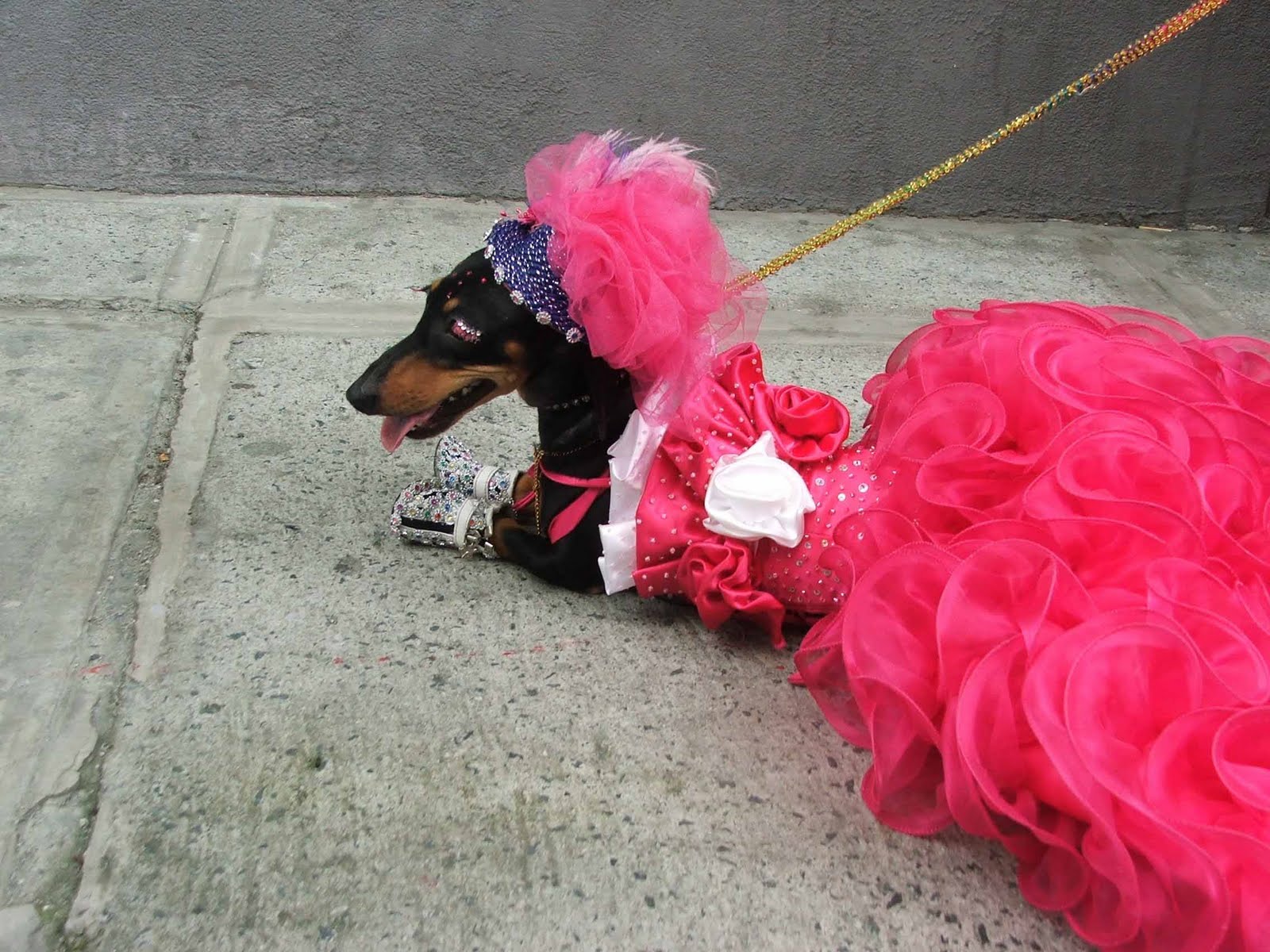
A Dachshund dressed as a drag queen in a dog club Packy attended.
Note the false lashes!

A Schemer in Our Midst
      When it comes to deviousness, Packy leads the pack. As I learned to train dogs, I ambitiously thought of training them to sing on command. Packy was already howling at a passing ice cream cart so it was a matter of transferring that cue from the ice cream cart to my command – followed by a biscuit. The little dog noticed early enough that a biscuit follows every time he “sings.” (He even got to make Toby, our other Dalmatian to sing as back-up. See my August post, “The Biscuit Jar”). One day, the dog wanted a biscuit. He had no access to food because mealtime was still an hour away. But he knew how he could get a biscuit -- if he sang.
      Thus, Packy waited until the next food vendor came along – and decided he would howl at it. It happened to be the “taho” (sweet soya dessert) vendor just calling out with his voice. But Packy is Toby’s cue so Toby automatically caught it up and carried the tone to higher (and longer) levels. We heard the racket from inside the house and noticed the dogs howling at a new sound. After singing, Packy scrambled up the house with Toby close behind and headed for the biscuit jar, expecting to be rewarded. We gave each a biscuit. He howled, didn’t he?

      But Packy didn’t stop there. Next, he decided to “expand” his understanding of this reward technique, testing how far it would apply. One day, standing before the gate he just howled – at nothing. Again, we inside the house wondered what he was howling at. There was no food vendor passing by. But Toby’s vocal acrobatics which followed enlarged Packy’s song, making it longer and louder, a singing duo’s racket you could not ignore. After that they headed up the house towards the biscuit jar and we, the amused owners, so taken by the antics, gave in to the expectant attitude.
      Dachshunds were originally born and bred to hunt underground and fight badgers, an animal slightly taller than them. It is a dog that doesn’t have any concept of size, height or fear. With this background and genetic makeup, the breed was developed to have a mind of its own so he can manage alone without depending on his master.  “He’s down there under the ground,” my brother-in-law once told me, “and he can’t see you there to wait for your command. He has to decide by himself on what to do.”
      Packy’s constant challenge to his superiors (and inferiors) has sometimes resulted in dog fights. Like a true fighter, the dog has a never-give-in battle attitude, screaming and fighting wildly even if held at the neck up in the air by Spot’s bigger jaws. I’ve never seen anything like it; between bigger dogs I see the lower ranked pack member back down soon after the fight erupts. The dogs are equally sized so I usually let them solve their issues. But if Packy is involved we have to do “rescue” work. The little dog fights back even if we manage to make Spot drop him. We have to bar Packy from attacking after he is released (short of throwing a net over him and dragging him away)! Without our interference this dog will go down fighting. . . (Now if I were Spot. . . with that piercing racket so close to his ears when he grasps that wriggling annoyance up in the air? I’d let him go down fighting just to stop the ear-splitting noise!).
Packy -- when he's not plotting how to outsmart us

      These dogs also solve their own problems actively but from their doggy point of view. Tutti, now called Tootsie, over at my elderly aunt’s house in another city, lives a solitary canine life with a basket of toys, a cat, a rabbit, my aunt and a household staff as company. Turned out the dog is ball driven. Her concept of doggy heaven is a non-stop game of fetch-the-ball.
      But when potential playmates are too busy to accommodate (which is often), Tootsie found a way in which she could have a ball tossed for her so she could chase it. One day, my aunt noticed a tennis ball bouncing down the steps from the upstairs bedroom – and saw the dog chase it.
      But the scene repeated itself again.
      And again.
      Curious, she looked to see the source of this unusual incident. At the top of the stairs she found Tootsie, swinging in the air by a loose thread an old tennis ball. After a few seconds the dog dropped the ball down the steps. As the ball bounced away, she chased it. . .
      Packy, meanwhile, tried to go around my rule about his being allowed his afternoon walk only if he's quiet and well behaved. He didn’t quite agree to that but I was the alpha. Those were the rules.
      But his proposal of a Win-Win negotiation is pure doggy. He still screams and shouts excitedly while being leashed until the instance he is at the gate. Then I hear the barking stop suddenly – almost like a hiccup – and I know where he is. He is immediately in front of the gate as the maid’s hand is probably on the knob. Then I hear the gate open and – his mouth opens again, announcing to the whole world he’s out. I hear the mayhem follow him down the road as the dogs from the other houses race to their front yards to bark and shout at the passing challenger.
      I shake my head in disbelief and amusement. The dog has outsmarted me. I want silence when it’s time for him to walk? I get that silence – but only at the last 2 seconds before the gate is opened. Then he gets his walk – plus the added license to yell and challenge all the dogs in the neighborhood (a point we didn’t talk about…).
     This breed is difficult to co-exist with other breeds unless its packmates are all submissive. This is one dog that will immediately assume leadership position (if you don’t claim it upon his arrival). A few years ago, I met Marie Grace, the cousin of a childhood friend of mine at a dinner gettogether. She walked in with a Dachshund. I was with Jonathan that time and our eyes lit up when we saw the dog. We had a dog school at the local park that time and we invited her to bring her dog there.
      Marie Grace reacted as if I gave her a mouthful. She can barely breathe, she complained, running her pastry breads business from the house and keeping her 3 dogs from taking over everything. Top of her conversation was her 3 dogs (1 of which was with her) and how they seemed to drive her crazy so she always has to keep an eye on them.
      The occasion we went to was the Catholic novena Mass of a common friend of ours whose mother had died 9 days earlier. During the home Mass, at a moment of silence and prayer, while everybody was standing up, the serenity was suddenly jolted by the sound of a dog's bark. My eyes roved to the sound and there was Marie Grace's Dachshund, looking up at his mistress, asking to be carried. His mistress obediently broke her prayers, bent down to gather the dog, and carried it in her arms as she stood up. 
      I heard Jonathan trying to remark between gnashing teeth, "No wonder the dog controls her. One bark from him and she obeys!"
      Other dog owners used to the compliant and dependent canine pet will be up for surprises when faced with this breed. This dog is no robot you can train to just obey at the push of a button.
      This dog has his own set of buttons. Make sure your name is not among them.

Thursday, September 2, 2010

The Devil Wears. . . a Maid’s Uniform (this is just a joke -- Part I)

      They spend more time with your dogs than you do.

      I don’t intend to scorn this one of the most can’t-live-without persons in the domestic household. If you’re a responsible and educated pet owner, you would, of course, teach all family members how to handle your pets the same way you would. Uniform and consistent handling of your pets at home is the key to a peaceful co-existence between them and us. That means training your maid/s too. They spend more time with your dogs than you do.
      Many of them are trainable anyway.
      But occasionally you will meet one you cannot train.
There Goes Your Investments
      Ching joined our household because my elderly father needed closer supervision in his daily life. She liked dogs too.
      It was Ching who undid all the training I invested in my dogs – and taught them bad habits. All the time, money, and effort I spent on teaching my dogs good habits drained away when she had her hands on them.
      I was working then and saw my home only in the evenings. So bad habits the dogs learned had plenty of time to establish before I noticed them.
      The daily afternoon walks, for one, taught the dogs to compete for the privilege to be walked out first. Whenever Ching brought out their collars and leashes the uproar was enough to disturb the neighbors. One weekend the riot was so bad I walked to the front of the house to watch the proceedings. I saw Packy, the little Dachshund, compete for the first to be walked, screaming and barking wildly. But I knew Spotty was the top dog so I stressed to Ching the importance of observing their hierarchical positions, a subject I’ve repeated to the househelp time and again. I reminded them Spot will not allow Packy to go over his head if it happens often enough.
      Ching does as instructed, leading Spot out first for a walk, but I noticed she does not do this consistently. One afternoon, there was a ferocious dog fight at our front door. By the time I got there, the maids had managed to separate the dogs and nobody would know what caused it.
      But I could guess.
      “Who was the dog you were preparing first?” I demanded of Ching.
      “Packy,” was the expected reply.
      “Packy is second. Spot is always first!” I protested furiously.
      “But Packy wanted to go out first,” she reasoned.
      Ching tested my patience severely because I was seeing the dogs’ training getting undone. Regardless of how many times I explained to her and the other household staff the reasons for why the dogs must be handled according to my direction, the look remained blank in her eyes. She couldn’t understand why.
      Our doggy gate, for example, which I installed at the entrance to our kitchen, was developed because of her.
Our doggy gate
       Ching was a great cook – and the dogs seemed to know it. Everyday when she’s preparing the meals, the dogs crowd around her in the kitchen, sitting on the floor expectantly because they’ve become accustomed to her throwing regularly a tidbit their way. After meals when she gets the empty plates in the dining room the dogs scramble from wherever they are and follow her into the kitchen. She tosses a leftover piece of meat here and another piece there, and the dogs know they get something all the time.
      The effect of this particular doggy habit I saw when I was at my aunt’s house for Christmas eve. Spot came in sporting a Santa cap to the delight of the guests. While everybody was in the living room chatting, my aunt’s maids started to get the dining plates. As soon as Spotty heard the clatter of plates and silverware, I saw the dog’s head spin around to the sound, with the intention of hurrying to the kitchen.
      I was horrified. Like a parent horrified to see one’s child display disagreeable conduct at another house, I reacted exactly the same way. I had to command the dog to stay where he was and not leave his place.
      That was Ching’s work. I had to install a doggy gate at the kitchen to bar the dogs from entering because they were being trained by Ching to find rewards there.
      Another undoing was her manner of walking the dogs. I used to teach Ching the proper heeling position with Spot whenever they go out into the street, to establish the dog’s training behavior. But one night, as she and another househelp named Lourdes was out walking the dogs, I happened to arrive from work. I saw Spot from a distance -- dodging a passing car. I thought the dog was loose. Then I saw Ching and Lourdes along the road walking away from me, their heads deep in gossip, Ching not looking at what was happening to Spot. She was using the retractable leash on the dog, the cord extended beyond a length I knew she could not manage.
      I had to stop the car by the road and chase them on foot.
     What was her reply when I demanded why she kept Spot on a long leash? From her point of view, because the dog was trained – “Spot knows what to do.” She felt she didn’t have to keep an eye on him.
      I got exasperated. What if they encountered stray dogs? A cat? A reckless driver? Or the dog saw a sharp bone on the road, or something poisonous like a dead toad? The dog “knows what to do”?
      Ching would’ve effectively reverted my dogs back to their wild ways hadn’t I always been there to fight the results of her handling. Regardless of my constant explanations, though the rest of the staff finally understood me and learned to follow, Ching never did. When she left after my dad died, I spent many weeks undoing the bad behaviors she allowed to develop with my furkids.
(more below)

The Devil Wears…a Maid’s Uniform (Part II)


       New maid, new reasons. Same damage.

      Whatever your lifestyle, if you have household help like we do, your dogs will spend more time with them than with you.
      You may bring home the dog food but they are the ones who will feed them.
      You may buy them their special shampoos but they are the ones who will bathe them.
      You may buy them good quality leashes or harnesses but they are the ones who will walk them out everyday.
      You may strive to bond with your dogs every weekend -- long walks in parks or in the countryside -- but your pets have bonded with your househelp earlier.
Here We Go Again
       Spot is the dog I took care of personally and my household is aware of this. Thus, they keep a respectful distance, as if to say, ”This is the boss’s dog.” So they spoil the other two dogs.
      Consequently, I find the other dogs faring badly (from my point of view, not from theirs). The two have formed a bond with our new maid, Lourdes. They also sleep in her room.
      Lourdes took over the care of the dogs after our other maid, Ching, left after my dad died. I didn’t need that many people in my household anymore. We prefer middle-aged women as househelp because they are more mature, have better managerial skills, better judgment, and don’t need meticulous training. But midlifers have a disadvantage: their ways have settled. Their minds are in the comfort zone.
New Maid, New Handling
      When it comes to Lourdes, it seems our pushy little Dachshund named Packy has taken over. Packy has taken it upon himself to train Lourdes. The result is bedlam with Packy and his partner-in-crime, Toby, having their way. These two dogs, in contrast to Spot, require constant supervision when we are all out together. They prefer to obey Lourdes.  
      But does Lourdes discipline them? She does not. Their wild antics are largely left to run free; she does not reward any good behavior either. Her reason for the doting tolerance is commonly seen in all uninformed dog owners.
      Dominic, Lourdes’ teenaged son, observed amusedly, “Mama treats Packy like her own grandchild.”
      At bedtime, I hear baby talk as Lourdes plays with Packy before they turn in for the night. Sometimes when Packy goes to bed earlier I catch him sleeping on Lourdes’ bed. I order him down.
      But -- I found out later – Lourdes lets the dog sleep on her bed during the night. Even though Packy has his own cozy little canine basket with pillows, he prefers Lourdes’ bed.
      I warned Lourdes, “This is a dominant  dog. If you let it sleep on your bed you are putting it on equal authority as yourself. You will not be able to make this dog easily obey you.”
      But did that concern Lourdes? It didn’t.
      Indeed. Dogs are any dog lover’s delight. Its antics amuse dog owners no end, especially with an assertive little Dachshund giving Lourdes endless surprises. But with a dog comes responsibility. A spoiled pet is an untrained pet.
      I would hear Lourdes chide Packy (or Toby) in a high singsong voice, “Hey, what are you doing again? Stop chewing that plastic! I’ve told you time and again you’re not supposed to do that!”
      Or, “Packy, you’re so noisy. Quiet down. I told you again and again you’re too noisy! If you’re noisy I will not take you out.”
      I used to correct Lourdes with her manner of talking to the dogs. “They don’t understand anything you say,” I’d warn her. “Your sentences are so long they don’t hear any one familiar word. Just use one word to command the dog.”
      One day it dawned upon me her high tone of voice actually mimics praise to the dog. She makes the dog believe his unruly behavior is right!
      No wonder she was getting nowhere.
      I’ve told this to Lourdes time and again. But like Ching, I felt I wasn’t getting anywhere with her either. Once, I got so fed up I exaggerated her singsong “doggy talk” so she can hear how she sounds. I didn’t hear the doggy talk for several weeks as she kept quiet.
      Then one day, I heard it again, “Packy, what are you doing here? You’re not allowed to go here. I’ve told you time and again you’re not allowed to enter the kitchen!”
Packy the Trainer
      I used to take everybody out for a walk along the river during the Christmas season to enjoy the lights and cool breeze. Packy enjoys himself to the hilt. The dog barks at any other passing dog, lunges at stray cats, and competes with Spot for the leadership position as they all walk along the lane. I’d watch Lourdes allow herself to be dragged by the small dog. I’d correct the positioning, admonish Lourdes for allowing Packy to lead her instead of the other way around, and things go right for awhile. Then I hear the patter of determined little feet behind me and I know. Packy is racing to position himself beside Spot. Lourdes is dragging behind him again.
      To discourage this competition, I would transfer with Spot to the lane across the river while Packy and Toby are walked on their side. Regardless, even though Spot and I pass by high bushes or a grove of tall trees, I hear that screaming dog’s voice travel over the waters from across the river, barking at other dogs or cats, and God knows anything that moves.

Packy, typical of his breed, was fearless and easy to train for the contact obstacles of agility sports.

      Once, I got Packy’s leash to prepare him to walk with me because I had a plan to review his old training. The dog had long learned his basic commands from me when he was younger. But succeeding maids (like Ching) had tolerated Packy’s misbehaviors.
      Packy refused to go out with me. He got on all fours and refused to get up.
The Price of Brattiness
      Unfortunately, all this boomerangs on them. When the handler is tolerant, the dogs are taken out less and less because of undisciplined behavior. On weekends as the dogs see signals for a ride in the car and a walk to a new place they circle the car excitedly, waiting for the cue for them to jump in soon as the door is opened. In the end, they find themselves barred from hopping in and watch with confusion as only Spot is allowed to enter the car and we drive away leaving them behind. It’s easier to just take Spot.